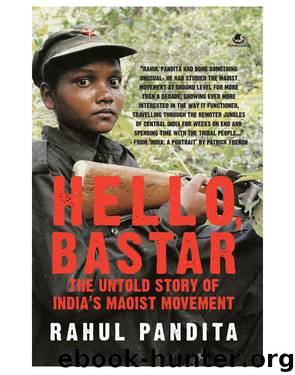
Hello Bastar by Rahul Pandita
Author:Rahul Pandita
Language: eng
Format: epub
Tags: Non-fiction/Current Affairs
Publisher: Tranquebar Press
Published: 2012-03-10T05:00:00+00:00
The Party's Organisational Structure
In February 2007, the CPI (Maoist) held its ninth Party Congress called the Unity Congress (the highest body of the Maoists is the Party Congress). It was held in high secrecy in the jungles of Bihar's Bheembandh area. The Congress was held in a huge area with a number of facilities available for those who attended it. Almost every senior Maoist leader, including its top brass attended the Congress. The area had a parade ground and a huge hall where strategies were discussed and debates held. It had a computer room with a team of operators and translators. Generators were put up that ran for 15 hours a day to enable computers, photocopiers and other electronic appliances to function. The Congress was set up next to a stream from where water was taken, boiled and then used for drinking purposes. An open kitchen ensured two meals and multiple rounds of tea for the 'delegates'. Various groups had been formed that were in charge of security, cultural performances, kitchen, health, media and even electric supply. The security was handled by senior Maoist leader and head of the eastern military command, Misir Besra alias Comrade Sunirmal (he was later arrested in September 2007 in Jharkhand and subsequently rescued by his men from a court in Bihar in June 2009). Many important strategies were discussed and announced during the Congress. It was agreed that till the establishment of Base Areas it is destruction (of enemy power) that will be the primary task and construction that will be secondary, and that in the process of establishment of Base Areas and their consolidation, the relation between destruction and construction gradually undergoes a change. The question of the nature and extent of the changes that have taken place in developed rural areas like Punjab was discussed and also whether in a country like India the election question was one of strategic significance or just another tactical question (it was decided finally that it is of strategic significance). Then a resolution was passed that called for the arming of the People's Liberation Guerilla Army with better weaponry and the arming of militia. It called for intensifying the war in the nine guerilla zones and four Red Resistance Areas and also spreading the war to new areas. Finally, it gave call for the immediate development of Dandakaranya and B-J (Bihar-Jharkhand) into Base Areas.23
In the period between two Congresses, the Maoists consider the Central Committee (CC) as their highest body. The Central Committee elects a general secretary of the party who acts as a sort of supreme commander. It also elects a Politbureau (PB). Between one Central Committee meeting and the next, the Politbureau is authorised to take political, organisational and military decisions that need to be later ratified in the subsequent central committee meeting. The general secretary also acts as the in charge of the Politbureau. The PB and CC are on the same level but the PB has special duties and responsibilities which it will fulfill on behalf of the CC in between two CC meetings.
Download
This site does not store any files on its server. We only index and link to content provided by other sites. Please contact the content providers to delete copyright contents if any and email us, we'll remove relevant links or contents immediately.
| Anthropology | Archaeology |
| Philosophy | Politics & Government |
| Social Sciences | Sociology |
| Women's Studies |
Cecilia; Or, Memoirs of an Heiress — Volume 1 by Fanny Burney(32543)
Cecilia; Or, Memoirs of an Heiress — Volume 2 by Fanny Burney(31939)
Cecilia; Or, Memoirs of an Heiress — Volume 3 by Fanny Burney(31928)
The Great Music City by Andrea Baker(31915)
We're Going to Need More Wine by Gabrielle Union(19032)
All the Missing Girls by Megan Miranda(15936)
Pimp by Iceberg Slim(14481)
Bombshells: Glamour Girls of a Lifetime by Sullivan Steve(14046)
For the Love of Europe by Rick Steves(13885)
Talking to Strangers by Malcolm Gladwell(13344)
Norse Mythology by Gaiman Neil(13343)
Fifty Shades Freed by E L James(13230)
Mindhunter: Inside the FBI's Elite Serial Crime Unit by John E. Douglas & Mark Olshaker(9313)
Crazy Rich Asians by Kevin Kwan(9274)
The Lost Art of Listening by Michael P. Nichols(7487)
Enlightenment Now: The Case for Reason, Science, Humanism, and Progress by Steven Pinker(7305)
The Four Agreements by Don Miguel Ruiz(6744)
Bad Blood by John Carreyrou(6610)
Weapons of Math Destruction by Cathy O'Neil(6261)
